


The record of foreign trade meets the documentation and information related to the import and export operations carried out by a company.
Their successful integration and retention allows you to maintain traceability of operations, to support the fulfillment of obligations and have the necessary information to consultations, revisions, or requirements related to foreign trade.
What is a record of foreign trade?
An international operation to generate various business documents, logistics, customs and regulatory.
Concentrating them within a file enables you to maintain organized records of the operation and check later information related to goods, suppliers, transportation, clearance and compliance.
It also facilitates internal processes of control and document review.
What documents can contain?
The documentation will depend on the type of operation and the applicable obligations.
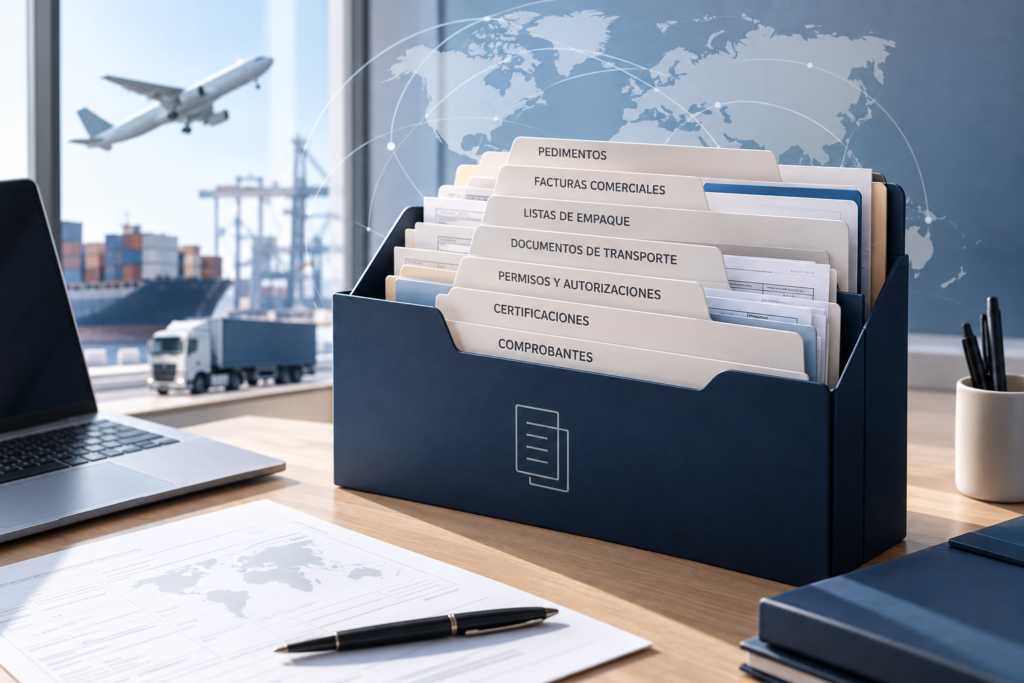
Among the documents that can form part of a file are:
- Applications and related documentation.
- Commercial invoices.
- Packing lists.
- Transport documents.
- Documentation related to the value of the goods.
- Certifications or documents related to the origin, where applicable.
- Permits and authorizations.
- Documentation relating to the enforcement of regulations and restrictions.
- Vouchers and other documents related to the operation.
Each record must be integrated with consideration of the particular characteristics of the movement, and the applicable provisions.
Why is it important to keep the documentation?
The information of an import or export may be necessary even after the goods have arrived at the destination.
Have documentation organized allows you to rebuild the operation, check the information that will be used during the process and address reviews or requirements when necessary.
It also facilitates internal audits and the historical analysis of the foreign trade operations of a company.
How to organize a record of foreign trade?
A practical way is to maintain an individual file for each operation and to establish uniform criteria for storing documents.
You can organize using information such as:
- Number or internal reference operation.
- Date.
- Vendor or customer.
- Type of operation.
- Goods.
- Motion.
- Commercial documentation.
- Documentation logistics.
- Permits and certifications.
- Evidence and proof related.
Digitize and standardize this process can facilitate the query and the document control, always bearing in mind the obligations that apply to the conservation of the information.
How much time should be kept to a file?
The retention schedule may depend on the type of document and of the tax provisions, customs and foreign trade laws.
For this reason, companies need to establish their conservation policies considering the existing obligations and the characteristics of their operations, avoiding remove documentation solely because the movement of logistics has been completed.
Record of foreign trade and traceability
Maintain traceability of an operation does not mean only knowing the route of the goods.
It also implies a need to have the information to document how it was every move.
A record organized makes it easier to control, to consultation and follow-up of the international operations are carried out by a company.
In Core Global Logistics, we understand that the information and coordination are essential elements within the international logistics, allowing it to maintain high visibility during the different stages of each operation.
Its Amazing